Knowledge
Listening longer: how to keep podcast audiences hooked til the end. A complete guide.


Creating a podcast means you've already put in the time, effort, money and resources to create a product that shines. Your brand is going to be invested in that product. The metric that everyone strives for is downloads, or listens. However, alone they can be vanity metrics. One of the best ways to measure real podcast engagement is seeing how many people listen until the end.
There's more to a podcast than numbers. If we're making podcasts that audiences love, then it has to be about podcast engagement too (these metrics are known as podcast consumption or completion rates). A podcast with listeners who tune out halfway through is a podcast that is wasting its resources, the time of the guests, and the time of the listeners. And remember, Apple's algorithm means podcasts with higher completion rates are more likely to appear in charts.
Fortunately, creating a podcast that keeps people hooked till the end isn't an unknowable art. There's a way to turn a good concept into something that is recommended by fans and technology alike. We can show you how to do that.
Monitor podcast engagement through your podcast stats
Before turning your listener base into an audience that follows each episode from start to finish, you need to dive into your data.
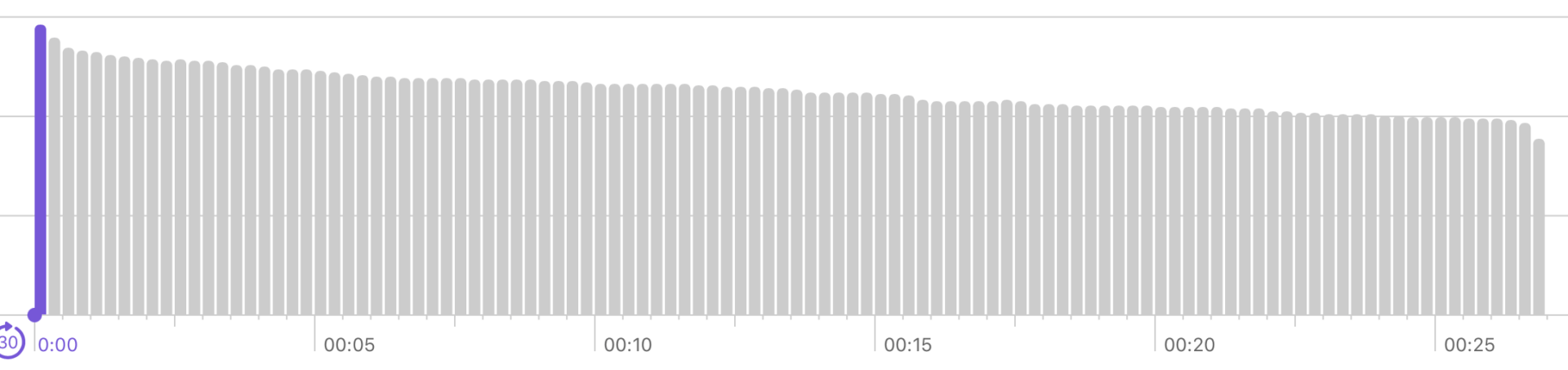
While information like listener numbers, their city, country, and other demographics can help you discern what content might appeal to them most and that you're reaching the right sort of audience, the one to really watch is completion rates. How much of an episode are your listeners staying tuned for? If it's not all of it, what can you do to keep their attention?
There's no one place to discover this. You can check your Apple Podcasts data (via Apple Podcasts Connect), your Spotify data (via Spotify for Creators), or, and this is what we love, plug your podcast into a platform like Bumper to aggregate all of this data in one place.
Whichever tool you're using, visualisations of user habits will be invaluable in reviewing your content. Are people skipping the intro or the mid-roll (useful to know if you're carrying ads)? Has there been a change in consumption habits since a format change was introduced? Are there particular guests who your audience don't seem to like? Is there a correlation between poor quality audio and listeners dropping off? Knowing the data is the first step to keeping your audience onside.
Here's what completion and consumption rates look like. We're always striving to keep listeners for upwards of 80% of an episode for our clients. Note that Apple and Spotify report them slightly differently.

That kind of tracking adds up. Counting Apple and Spotify alone, A Life More Wild has now been listened to for more than 200,000 hours, over 23 years of continuous listening, and that's a conservative count, before you add every other platform on top.
How Do You Increase Podcast Completion Rates?
The main ways to increase podcast completion rates are planning your episode structure in advance, using segments to vary the pace, using the throw-forward technique to carry listeners through ad breaks, adding music and sound design, and editing tightly. Aim for at least 80% completion, and treat anything lower as a sign something in the episode needs attention.
Plan out your podcast episodes
A good podcast should feel like meeting a familiar friend. Listeners like to know what to expect, episode after episode. If you're making a podcast from scratch, come up with a structure and stick to it, there's always room to tweak it. If you already have a podcast, see where the existing ebbs and flows of your episodes are. Trim any parts that aren't working, and formalise the rest into something more structured.
A good podcast should feel like meeting a familiar friend. Listeners like to know what to expect, episode after episode
Consider features and segments
By planning your episode, you'll soon see room to insert features and segments. We all love a good interview or story, but it's not hard to tune out of something if it stays tonally flat. To remedy this, try splitting your podcast into segments.
Smartly segmenting your episodes, and allowing segments to segue naturally and smoothly from one to the next, will help change the pace up and down. It gives audiences the consistency that keeps them coming back and, importantly, helps you hold their attention.
Use the throw forward
"Coming up next... later... at the end, we have..." We've heard it before. The best radio hosts are masters at this, and for good reason. It keeps the audience engaged. If a listener knows what to expect in an episode, they know what to stay tuned for. This is true for each instalment, but it also applies on a smaller scale: tell the listener not to go anywhere, and what to expect, shortly before the advertisements roll. We've seen podcasts where listeners drop off simply because they assume an interview's finished.
Use Music and Sound Design
A podcast doesn't need to just be a dry conversation between two people, although it can be. You have complete control. Music can be the emotional underscore that brings a scene to life. Or use a trick from radio's book: the right sting, indent, or sonic branding can punctuate a conversation exactly before it veers off track.
For inspiration, Radiolab are masters at this. Music and the sounds of nature helped create a zen-like quality for our podcast A Life More Wild.

Edit Tightly
A good podcast editing rule of thumb is to have a target length to aim for, and edit out what you can without losing substance. When it comes to getting better podcast engagement, the skill is in knowing which parts to take out whilst leaving the gold behind.
If the second half of a guest's answer only serves to reiterate the first, you could argue it isn't necessary. Conversational tangents may be fascinating to you, but your podcast isn't for you, it's for your listener. This is where knowing your audience, and your podcast's DNA, is your guiding light.
One judicious approach is to have someone else listen through an edit, or multiple edits. The ears of someone slightly removed from a project can be the distance needed to know which parts could be cut to really make the episode sparkle.
In closing
Our background is in radio. Podcasts have had a period of exponential growth, and there's a lot of advice out there. Ours comes from years of experience. If you'd like to know more about increasing your podcast engagement levels, contact us today. We're one of the best podcast production companies in the UK, and we don't mind saying so.
Sign up to our newsletter
Sign up to read about the thinking behind the shows – strategy, trends and the odd strong opinion, straight to your inbox.